Episode summary
Crushing cooked agave is where romance meets weight.
In Episode 5, Agave Boy watches roasted agave come out of the pit and assumes the hard part is over. Tahona Donkey turns slowly, looks directly at the reader, and says nothing — because the stone wheel is already making the point.
The tahona is a heavy stone wheel used to crush cooked agave. It can be pulled by an animal or powered mechanically, depending on the producer and setup. Either way, it represents one of mezcal’s most iconic production images — and one of the easiest to romanticize without respecting the labor.
Tahona Donkey says:
“Before calling this rustic and charming, please move the stone wheel around the courtyard. I will supervise from the shade.”
Panel 1: The roasted agave pile
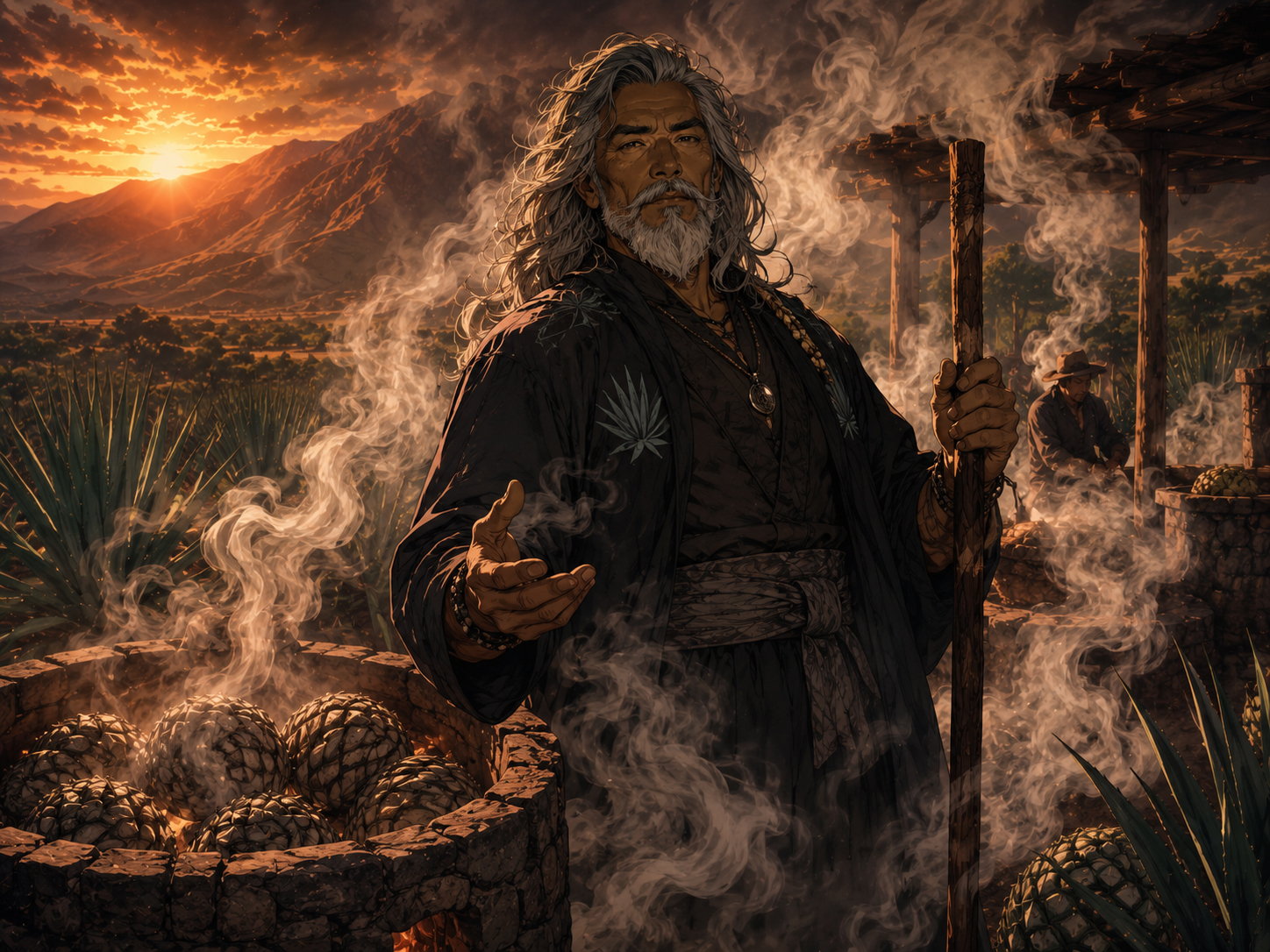
The episode opens with roasted agave cooling in the courtyard. The piñas are soft, sweet-smelling, smoky, fibrous, and heavy. Agave Boy pokes one with a stick and says, “Now it becomes mezcal?”
Smoke Sensei shakes his head. “Not yet. First, the agave must give up its sugars.”
Panel 2: The tahona wheel appears
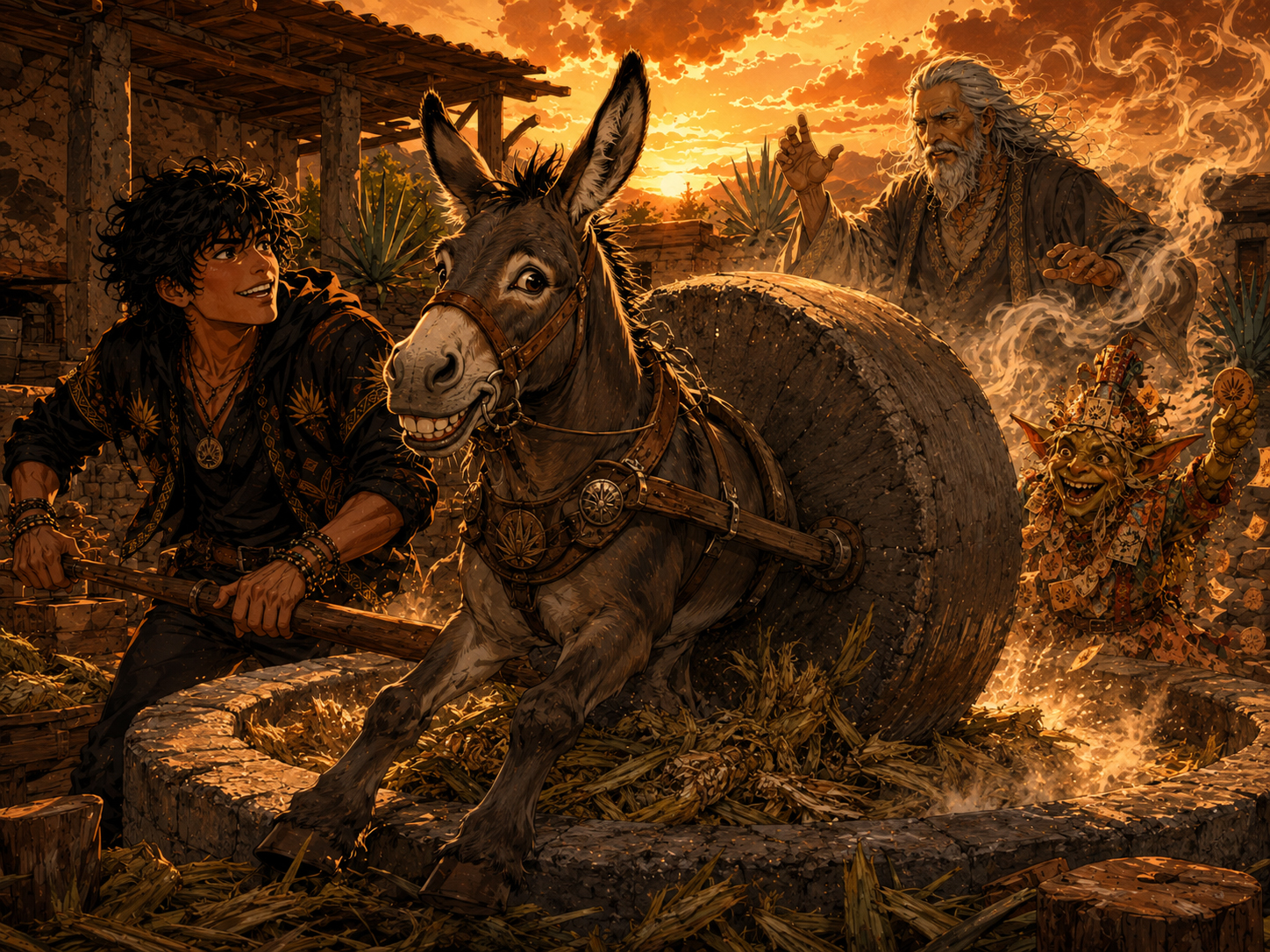
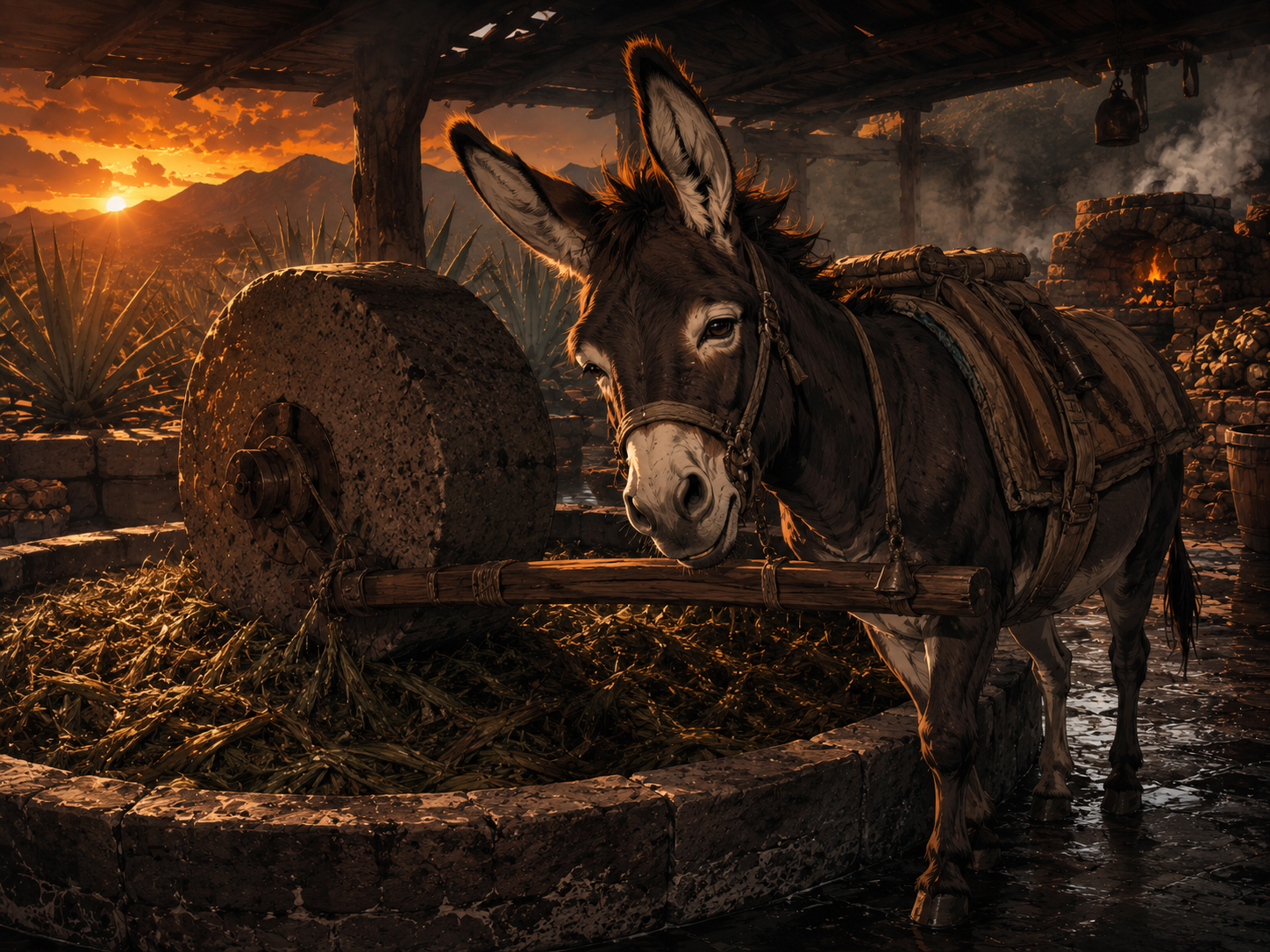
A giant stone wheel rolls into view. The soundtrack becomes heroic. Dust rises. Tahona Donkey enters wearing the expression of someone who has heard too many tourists say “adorable” while ignoring the workload.
“This is not decoration,” says Tahona Donkey. “This is production.”
The tahona crushes cooked agave fibers so the sugars can be available for fermentation. Crushing is not a side quest. It is essential.
Panel 3: Agave Boy learns what crushing does
Agave Boy watches the stone wheel move over cooked agave. Fibers tear apart. Juice and sugars release. The roasted material becomes ready for fermentation.
Tahona Donkey explains that crushing method can affect texture, extraction, fermentation material, and final character. The crushing step is one more place where method leaves fingerprints on flavor.
| Crushing method | What it does | MezcalDaily translation |
|---|---|---|
| Tahona | Stone wheel crushes cooked agave slowly and physically. | The boulder has a job. |
| Hand crushing | Cooked agave may be broken down manually with tools. | Labor with splinters and dignity. |
| Mechanical mill | Machines shred or crush agave more efficiently. | The modern helper with less romance and more speed. |
| Producer choice | Each method affects extraction and fermentation preparation. | The maker chooses the path from roast to ferment. |
Panel 4: The Label Goblin tries to sell “donkey-powered vibes”
The Label Goblin appears with a sticker that says “ANCIENT DONKEY MAGIC.” Tahona Donkey stares at him until the sticker curls up from embarrassment.
“Do not turn labor into a mascot,” says Madame Terroir.
This is an important episode note. Traditional tools are beautiful, but they are not props. A tahona wheel can be photogenic, but behind the image is real labor, real skill, and real production purpose.

Panel 5: Tahona vs mechanical mill
Agave Boy asks whether tahona crushing is automatically better than mechanical milling. Tahona Donkey sighs with the patience of a working animal who has become an internet aesthetic.
The answer: not automatically. A tahona can be part of a beautiful process. A mechanical mill can also be used by a skilled producer to make excellent mezcal. The tool matters, but the maker still matters.
Madame Terroir’s ruling
“Traditional tools can matter deeply. But do not replace tasting, transparency, and producer skill with tool worship.”
Panel 6: The crushed agave heads to fermentation
The crushed agave is moved toward fermentation vessels. This is where sugars become alcohol and flavors can develop in wild, complex, beautiful ways. The tahona’s job is to prepare the agave for this transformation.
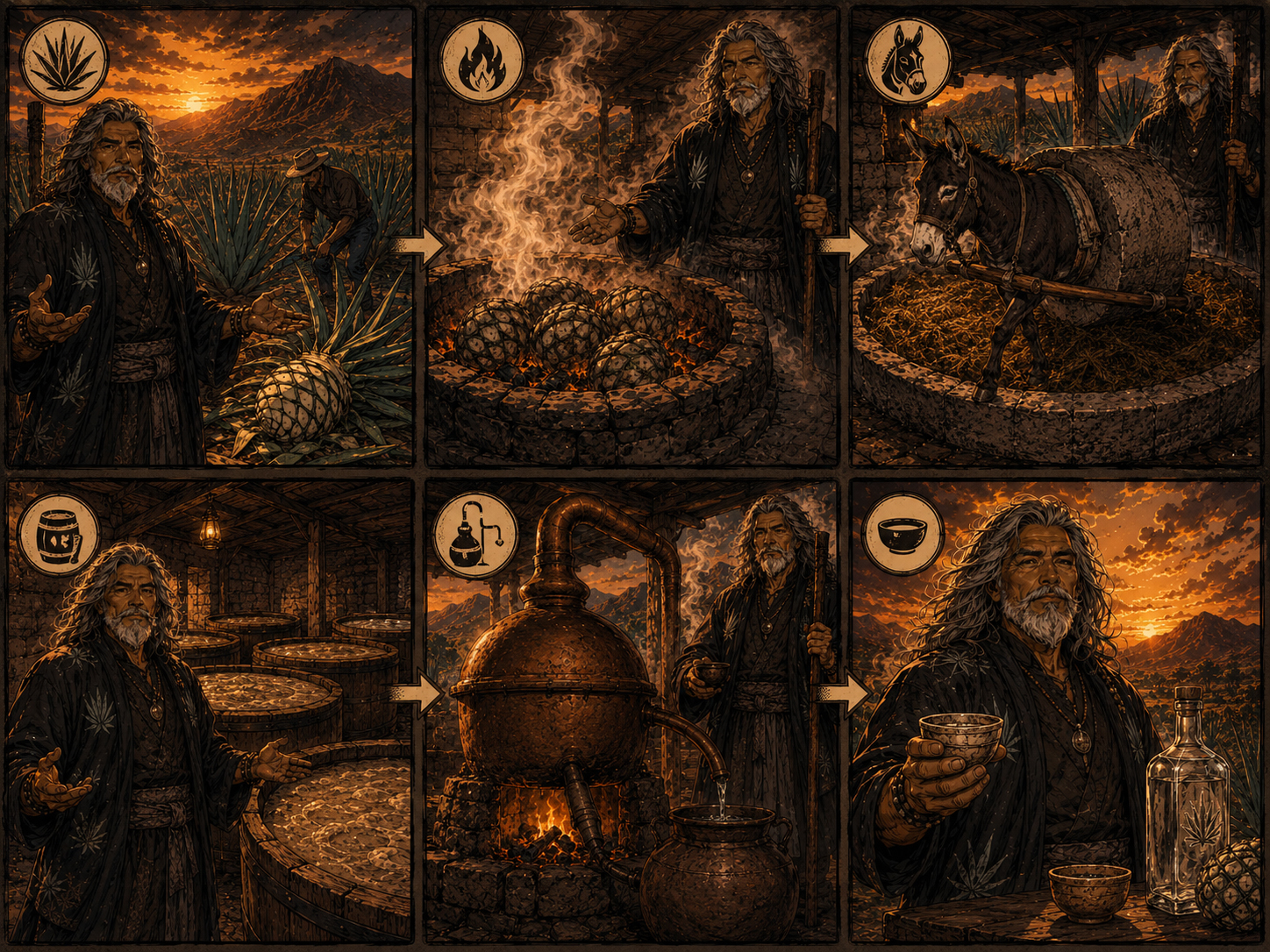
Agave Boy finally understands the production chain:
- Grow the agave.
- Harvest the piña.
- Roast the agave.
- Crush the cooked agave.
- Ferment the sugars.
- Distill the result.
- Bottle the mezcal.
Panel 7: Texture enters the lesson
Tahona Donkey explains that production choices can affect texture. A mezcal might feel oily, round, dry, sharp, rustic, soft, dense, or bright. Crushing is one part of the chain that helps determine what material enters fermentation and how the final spirit may feel.
| Texture word | Plain meaning | Donkey comment |
|---|---|---|
| Oily | Coating and full-bodied. | “The glass has shoulders.” |
| Rustic | Earthy, textured, less polished. | “Not a flaw by itself.” |
| Soft | Gentle and rounded. | “Quiet can still be strong.” |
| Sharp | Bright, hot, or angular. | “Sometimes useful, sometimes rude.” |
Panel 8: Tahona Donkey saves the day
The Label Goblin tries one final trick: “Just say tahona means premium!”
Tahona Donkey steps onto the label and corrects it:
“Tahona means method. Quality still depends on plant, place, producer, fermentation, distillation, balance, and honesty.”
Agave Boy writes the real lesson in his notebook. The donkey finally gets a carrot and a union break.
What this episode teaches
- Crushing is essential. Cooked agave must be broken down before fermentation.
- Tahona is a stone wheel. It is iconic, heavy, and production-focused.
- Traditional tools are not props. They represent real labor and skill.
- Tahona does not automatically mean better. Producer skill still matters.
- Mechanical mills are not automatically bad. Good mezcal can come from different methods.
- Method notes help labels make sense. Look for oven, crushing, fermentation, still, ABV, and batch.
Episode 5 tasting homework
Find a mezcal label that mentions its crushing method. If it says tahona, mechanical mill, hand-mashed, or another method, write that down. Then taste a tiny pour and focus on texture: oily, dry, soft, sharp, rustic, round, or hot.
Responsible homework rule
Tiny pour. Slow sip. Water nearby. Food on the table. No driving after drinking. Also: do not ask a donkey to validate your tasting notes.
The final panel
The courtyard glows at sunset. Crushed agave heads toward fermentation. Tahona Donkey stands beside the stone wheel, finally respected.
Tradition is not a decoration. It is work, knowledge, tools, time, and care.
Responsible drinking note
MezcalDaily.com is for adults of legal drinking age. This episode is educational and cultural content about an alcoholic beverage. Sip slowly, hydrate, eat food, and do not drink and drive.